Still Bloated — Despite Changing What You Eat?
An evidence-based guide to understanding why bloating and distention happen — and what you can do when food changes alone haven’t been enough.
One day your clothes fit comfortably.
The next, your stomach feels tight, swollen or painfully full before lunch.
You start wondering what you ate.
Again.
So you cut something else out.
Gluten. Dairy. FODMAPs. Sugar.
Perhaps you try another probiotic, digestive enzyme or anti-bloat remedy.
And for a while, you think you may have cracked it.
Then the bloating comes back.
If that cycle sounds familiar, the problem may not be that you haven’t tried hard enough.
It may be that you’ve only been given part of the picture.
Persistent bloating isn’t always just about what you eat.
Food can matter.
But so can gut sensitivity, motility, abdominal muscle responses, digestive contents and the two-way communication between your gut and brain.
That wider picture is what Tired of the Bloat? is designed to help you understand.
GET - TIRED OF THE BLOAT
114-page digital guide
Evidence-based
Instant access
Read at your own pace
Before you try another restriction, understand what you’re actually experiencing
One of the most useful things to know about bloating is also one of the most commonly missed: Bloating and distention are not the same thing.
Bloating is the sensation of abdominal pressure, fullness or swelling. You can feel intensely bloated even when your abdomen looks no different.
Distention is an actual, observable increase in the size of your abdomen.
The two often occur together. But they don’t always. And that distinction matters because different mechanisms may be contributing to each. Once you understand what you’re dealing with, you can start moving away from guesswork and towards strategies that are better suited to the problem.
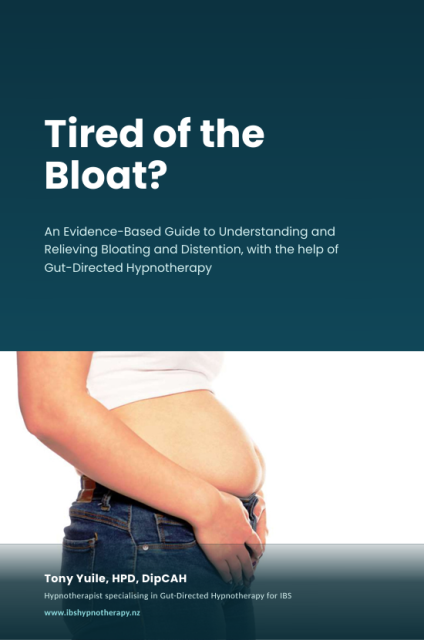
An Evidence-Based Guide to Understanding and Relieving Bloating and Distention, with the Help of Gut-Directed Hypnotherapy
Created by Tony Yuile, HPD, DipCAH
Hypnotherapist specialising in Gut-Directed Hypnotherapy for IBS
This 114-page guide brings together the digestive, nervous-system and gut–brain pieces of persistent bloating in clear, practical language.
No gastroenterology textbook.
No miracle promises.
No list of another twenty foods to remove.
Instead, you’ll learn what can contribute to bloating and distention, why traditional approaches don’t always provide sufficient relief, and where gut–brain therapies such as gut-directed hypnotherapy may fit.
Inside the guide
🧩 Why bloating isn’t simply “too much gas”
Bloating can involve far more than the volume of gas in your digestive system.
You’ll explore visceral hypersensitivity, altered motility, gut contents, muscular responses and other factors that may influence what you feel.
🧠 Why your gut and brain need to be considered together
Your digestive system and nervous system are in constant two-way communication.
In IBS and other disorders of gut–brain interaction, that signalling can become altered or sensitised.
The result can affect the way digestive sensations are noticed, interpreted and experienced.
⚡ How threat-related nervous-system activation can affect digestion
A stressor is an internal or external event or stimulus that activates the autonomic nervous system.
When we believe we have the resources to meet a demand, it is experienced as a challenge stressor and creates pressure.
When we believe we cannot adequately meet that demand, it becomes a threat stressor and activates the survival response.
Chronic stress means persistent distress associated with prolonged or repeated threat-related activation.
That matters because ongoing autonomic activation can influence gut sensitivity, motility and other digestive processes.
This is not about being told to “just relax.”
It is about understanding physiology.
🔄 The stress–bloat cycle
A digestive sensation appears.
You wonder what caused it.
You anticipate how bad it might become.
You start thinking about the meeting, journey, meal or social event ahead.
That anticipation of a possible future threat is anxiety.
The mental process of identifying and imagining those possible threats is worry.
And as autonomic activation increases, gut sensations may become more noticeable or uncomfortable.
The result can become a self-reinforcing cycle:
Symptoms → perceived threat → increased autonomic activation → greater gut sensitivity → more symptoms
Understanding the cycle gives you somewhere new to intervene.
🔎 The other causes that need to be considered
This is not a book that blames every bloated stomach on the nervous system.
Bloating and distention can have multiple contributors.
The guide also explores medical and overlapping causes and includes a dedicated section on endometriosis.
It explains why persistent or recurrent symptoms should be discussed with an appropriate healthcare professional rather than self-diagnosed.
🎧 Where gut-directed hypnotherapy fits
Gut-directed hypnotherapy is a brain–gut behavioural therapy supported by more than four decades of clinical research in IBS.
You’ll learn:
What hypnosis actually is
A goal-directed communication process that engages attention, belief and imagination.
What it isn’t
Loss of control, unconsciousness or somebody taking over your mind.
How gut-directed hypnotherapy is used
And why working with the nervous system and gut–brain communication may be useful for some people with IBS-related symptoms.
You don’t have to “believe in hypnosis.”
You can understand the evidence, understand the process and decide for yourself whether it is something you want to explore.
🛠️ Practical ways to begin
This isn’t just a book about theory.
You’ll also find practical relief strategies, a simple self-hypnosis approach, stories of change and a framework for mapping your next steps.
The goal is not to make you dependent on another expert.
It is to help you understand your own experience more clearly and make better-informed choices.
This isn’t another “just manage your stress” message
If somebody has previously told you your bloating is “just stress”, you may have found that explanation frustrating or dismissive.
That isn’t the message here.
Your symptoms are physical.
Your digestive system is physical.
Your nervous system is physical.
And the gut and brain communicate continuously in both directions.
Understanding that relationship does not mean every symptom is caused by stress.
It means the nervous system may be one important part of a much larger digestive picture.
And if that part has never been addressed, another food restriction may only take you so far.
This guide may be right for you if…
You’re managing a busy professional or family life while privately planning around your stomach.
You’ve already experimented with diet, supplements or medication but still experience persistent bloating.
You’re tired of continually restricting what you eat without understanding why symptoms keep returning.
You want a credible explanation rather than another wellness trend.
You’re interested in the gut–brain connection but want the science explained clearly.
You’re curious about gut-directed hypnotherapy but skeptical enough to want to understand what it actually involves first.
You want practical options without turning your life into another health project.
Most of all…
You want to understand your bloating before you remove another food.
Medical disclaimer
This book is for general information and education only and is not a substitute for medical advice, diagnosis or treatment. Please consult your GP, gastroenterologist or another appropriately qualified health professional about persistent, changing or concerning gastrointestinal symptoms.