The 4As of IBS Relief
Most people with IBS aren’t really “managing” it – they’re quietly running their lives around toilets, flare‑ups, and meetings they’re scared to sit through.
Management isn’t the same as resolution.
You need a specific framework to take back control of your gut.
Why?
Because IBS is not just a “sensitive stomach.” It’s recognised as a disorder of gut–brain interaction (DGBI). That means there’s no structural damage, but there is dysregulated communication between your central nervous system (brain) and the gastrointestinal tract (gut).
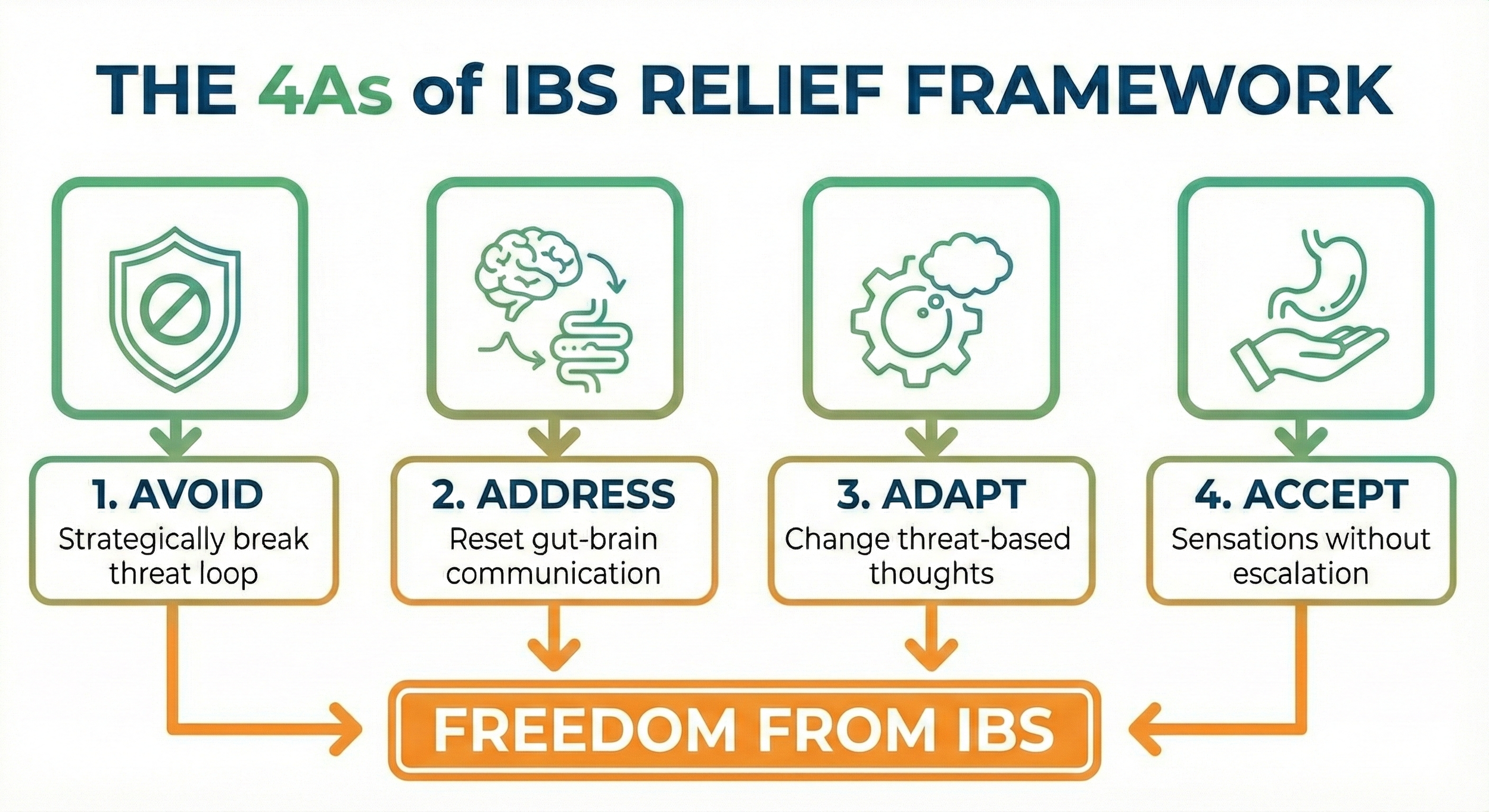
Here’s the 4A framework/model I use with clients to reset the gut–brain axis:
Avoid → Address → Adapt → Accept.
Avoid (Strategically, Not Fearfully)
When IBS first flares up, avoidance feels logical. You avoid certain foods, travel, restaurants, long meetings, social events, and anything that might trigger a flare in public.
Sometimes that’s sensible, if something consistently aggravates symptoms, short‑term avoidance can reduce immediate distress.
The problem is when avoidance is driven by fear.
Your nervous system starts to learn: “The world is dangerous. My gut is fragile. I’m not safe.”
That keeps your survival system switched on.
When the autonomic nervous system stays activated, digestion doesn’t function optimally, motility changes, sensitivity increases, and pain thresholds drop.
Avoidance can quietly reinforce the very ‘threat- stress- symptom’ loop you’re trying to escape.
So the first step isn’t eliminating avoidance; it’s becoming conscious of why you’re avoiding: strategy or fear?
Address (The Nervous System)
Chronic activation of the survival response changes gut motility, visceral sensitivity, inflammation, and even microbiota balance.
In clinical research, gut‑directed hypnotherapy has reduced IBS symptoms by around 70–80% in many patients, often with long‑term results because it resets the gut–brain communication pathway to its natural, normal functioning.
Addressing IBS properly means:
Calming the autonomic nervous system
Reducing threat perception
Interrupting the symptom–stress loop
Restoring “rest‑and‑digest” physiology
This is the core of the work inside my Gut-Brain Connection Program.
We reset the nervous system first, because without safety, the gut won’t stabilise.
Adapt (Thoughts and Behaviours)
Stress is not the enemy.
Stress is a felt signal that your body has mobilised to meet a perceived demand.
If you believe you can meet that demand, you feel pressure (which can be energising).
If you believe you can’t, your nervous system registers threat and the survival response activates.
Many professionals with IBS live in a state of chronic perceived threat:
“What if I flare up in that meeting?”
“What if I’m caught short?”
“What if this never improves?”
Worry drives anxiety.
Anxiety keeps the nervous system primed.
The gut responds accordingly.
Adaptation means retraining:
How you interpret bodily sensations
How you respond to early symptoms
The beliefs you hold about the condition and your ability to gain relief
The behaviours that reinforce the threat- stress- symptom’ loop
This is where gut-directed hypnotherapy, CBT‑informed tools, and nervous system retraining work together as tools to restore balance and control.
Accept (Safety, Not Surrender)
This is often the hardest “A.”
Accepting is not giving up or resigning yourself to suffering.
It’s teaching your nervous system: “I can experience this sensation without escalating into panic.”
When you stop fighting every twinge, the perceived threat level drops.
When the threat level drops, physiology shifts.
When physiology shifts, symptoms often reduce in frequency and intensity.
Acceptance creates space for more normal gut–brain communication to return.
The Bigger Picture
Many people with IBS come to me after years of:
Elimination diets
Supplements
Medication
“Managing stress” without really understanding what that means for the gut–brain axis
They don’t need more restriction.
They need a framework that brings together gut‑directed hypnotherapy, nervous system regulation, and cognitive and behavioural retraining, plus practical tools they can use in daily life.
That’s what I’ve built into the Gut-Brain Connection program
Not to “manage IBS forever,” but to retrain the gut–brain axis so your system can stabilise and your life can expand again.
IBS is real. It’s physical. And it’s deeply intertwined with how your survival system interprets the world. and your body.
If you live with IBS, which “A” are you in most of the time right now – Avoid, Address, Adapt or Accept?
Important Information: This blog post is for general informational purposes only. It is not personal medical advice and is not a substitute for assessment, diagnosis, or treatment from your GP, gastroenterologist, or another appropriately qualified health professional. If you are experiencing gut issues and/or persistent anxiety or have concerns about your mental health, please consult your GP or a registered health practitioner as soon as possible.